
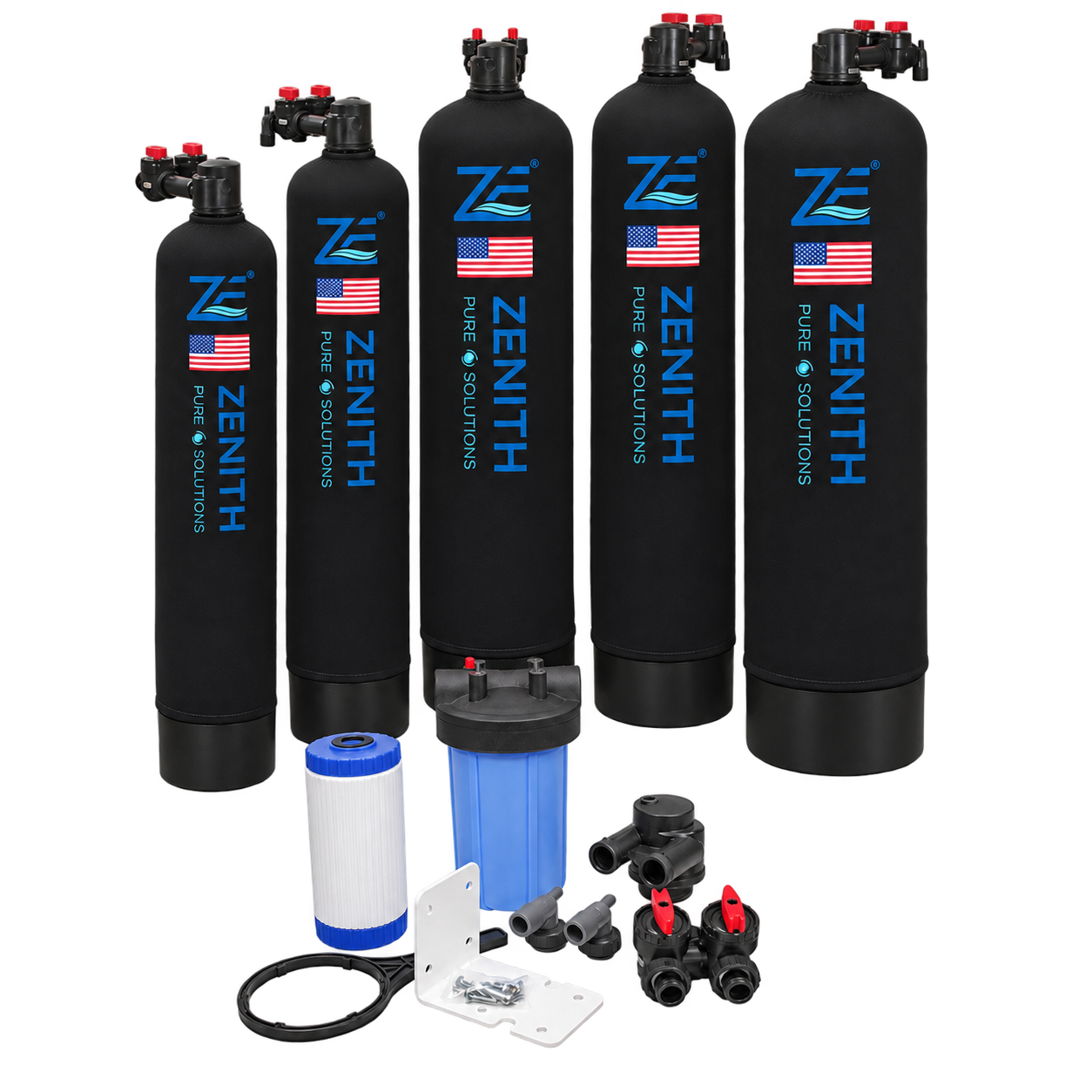
Some sites cannot take a softener. There is no floor drain, no room for a brine tank, or the lease will not allow the plumbing. A salt-free conditioner protects the same equipment by a different route, and it is not a softener.
Free on-site assessment · Written quote before any work starts · Indianapolis-based install and service team
- 10 to 25 GPM Peak flow per tank, in five sizes
- Under 2 sq ft Floor space per tank, with no brine tank beside it
- 3 to 5 years Media life before it is replaced, depending on your water
- No salt No drain, no power and no control valve
What it does and what it does not do
What it does
Filtersorb SP3 media converts hardness minerals into stable crystals that stay suspended in the water instead of depositing on surfaces. It prevents new scale forming, and over time it helps lift scale already sitting in pipes and on heat exchangers.
Nothing is added to the water and nothing is taken out. There is no salt and no added sodium, and the calcium and magnesium stay in the water. Dissolved solids and pH are the same after the system as before it.
What it does not do
It is not a softener and we will not sell it as one. It does not remove hardness. A hardness test after the system reads the same as before it, the minerals are still in the water, and the water will not feel soft. That is how the technology works, not a shortcoming.
Start with your peak flow
A softener is sized by grains. A salt-free system is sized by flow, because the water needs only seconds of contact with the media. The question is how many gallons a minute pass through at your busiest moment.
| Tank size | Peak flow (GPM) | Height (in) | Depth (in) | Width (in) |
|---|---|---|---|---|
| 8 × 44 | 10 | 49 3/8 | 14 1/4 | 8 1/2 |
| 9 × 48 | 12 | 53 3/8 | 14 5/8 | 9 3/8 |
| 10 × 54 | 15 | 59 1/2 | 15 1/4 | 10 5/8 |
| 12 × 52 | 20 | 57 7/8 | 16 1/4 | 12 5/8 |
| 13 × 54 | 25 | 59 1/2 | 16 3/4 | 13 5/8 |
Peak flow is the maximum service flow at up to 25 grains per gallon of hardness. Indianapolis city water runs about 19. Height, depth and width are the overall size of the installed system. Figures are the manufacturer’s specifications and are confirmed in your written quote.
More than 25 gallons a minute? Larger sites use two or more tanks side by side, each carrying a share of the flow. We specify that at the assessment.
Then the room and the water you have
Where a softener needs a drain, a brine tank and a power outlet, this needs a patch of floor and a connection to the water line.
- Floor. Under two square feet per tank. There is no brine tank beside it.
- Height. The tallest system stands just under 60 inches.
- No drain. Water flows up through the media and out. There is no backwash and no regeneration.
- No power. No control valve and no electrical connection. The inlet and outlet are 3/4 to 1 1/4 inch.
What the water has to be
| Feed water | Limit |
|---|---|
| Hardness | Up to 75 grains per gallon |
| pH | 6.5 to 8.5 |
| Iron | Less than 0.3 ppm |
| Manganese | Less than 0.05 ppm |
| Copper | Less than 1.3 ppm |
| Free chlorine | Less than 3 ppm |
| Oil and hydrogen sulfide | None |
| Water temperature | 41 to 149°F |
| Water pressure | 15 to 100 psi |
We check your water against these limits at the assessment. Well water often fails them on iron, manganese or sulfur, which is why this system is specified for city water only. In a new building with new copper pipe, the manufacturer advises waiting six weeks of water use before the system goes in.
Where it fits and where it does not
Where it fits
Scale protection without the plumbing
- Sites with no floor drain, or no room for a brine tank
- Leased spaces where plumbing changes are limited
- Protecting water heaters, boilers, coffee and ice equipment from scale
- Sites that want nothing to refill and nothing to program
Where it does not
When a softener is the right answer
- Where soft water itself is the requirement: guest rooms, laundry, anywhere the feel of the water matters
- Equipment whose maker specifies a hardness figure
- Well water with iron, manganese or sulfur
When we will tell you to buy a softener instead. Where soft water is the actual requirement (guest rooms, laundry, anywhere the feel of the water matters, or any application that specifies a hardness figure), a conditioner is the wrong product and we will say so at the assessment. This is scale protection, not softening, and it is sold on that basis.
What you maintain
There is no salt to buy and nothing to program. The media is not used up by the process. It is replaced every three to five years, depending on your feed water. A carbon pre-filter is installed ahead of the media and included with the system, and its cartridge is changed on the schedule in your service plan.
The media manufacturer lists Filtersorb SP3 as certified under NSF/ANSI 61 through the Water Quality Association.
Salt-free questions
Can I use a salt-free system instead of a softener?
Only if scale protection is what you need. A salt-free conditioner stops hardness minerals depositing as scale, which protects heaters, boilers and equipment, and it needs no salt, no drain and no power. It does not soften the water: hardness still tests the same and the water will not feel soft. If soft water itself is the requirement, for laundry or guest rooms, you need a softener. It is also for city water only, not well water.
How is a salt-free system sized?
By peak flow, not by grains. Each of the five tank sizes carries 10 to 25 gallons a minute at up to 25 grains per gallon of hardness. Sites that need more flow use two or more tanks side by side.
Will salt-free treatment remove scale that is already there?
It helps. As well as preventing new scale forming, the media gradually lifts scale already sitting in pipes and on heat exchange surfaces. It is a slow effect over months rather than an immediate clean.
Does salt-free scale prevention work on well water?
No. It is specified for city water only. Iron, manganese and hydrogen sulfide foul the media, and those are well water conditions. If your site is on a well you need a different approach and we will say so.
Does it change the water?
It does not add or remove anything. There is no added sodium, the calcium and magnesium stay in the water, and dissolved solids and pH are unchanged. A hardness test reads the same before and after.
How often does the media need replacing?
Three to five years, depending on your feed water. There is no salt to top up and no regeneration in between, so the media change is effectively the whole maintenance cycle.
Does it need power or a drain?
Neither. Water flows up through the tank and out, so there is no backwash cycle, no drain connection, no electrical supply and no control valve to program.
Find out what is in your water
The on-site assessment is free. We test your water at your site, inspect any system already installed and give you a written quote, with no obligation.
Hardness figure: Citizens Energy Group 2025 water quality report, 317 ppm, about 19 grains per gallon. Flow rates, sizes and feed water limits are the manufacturer’s specifications.