
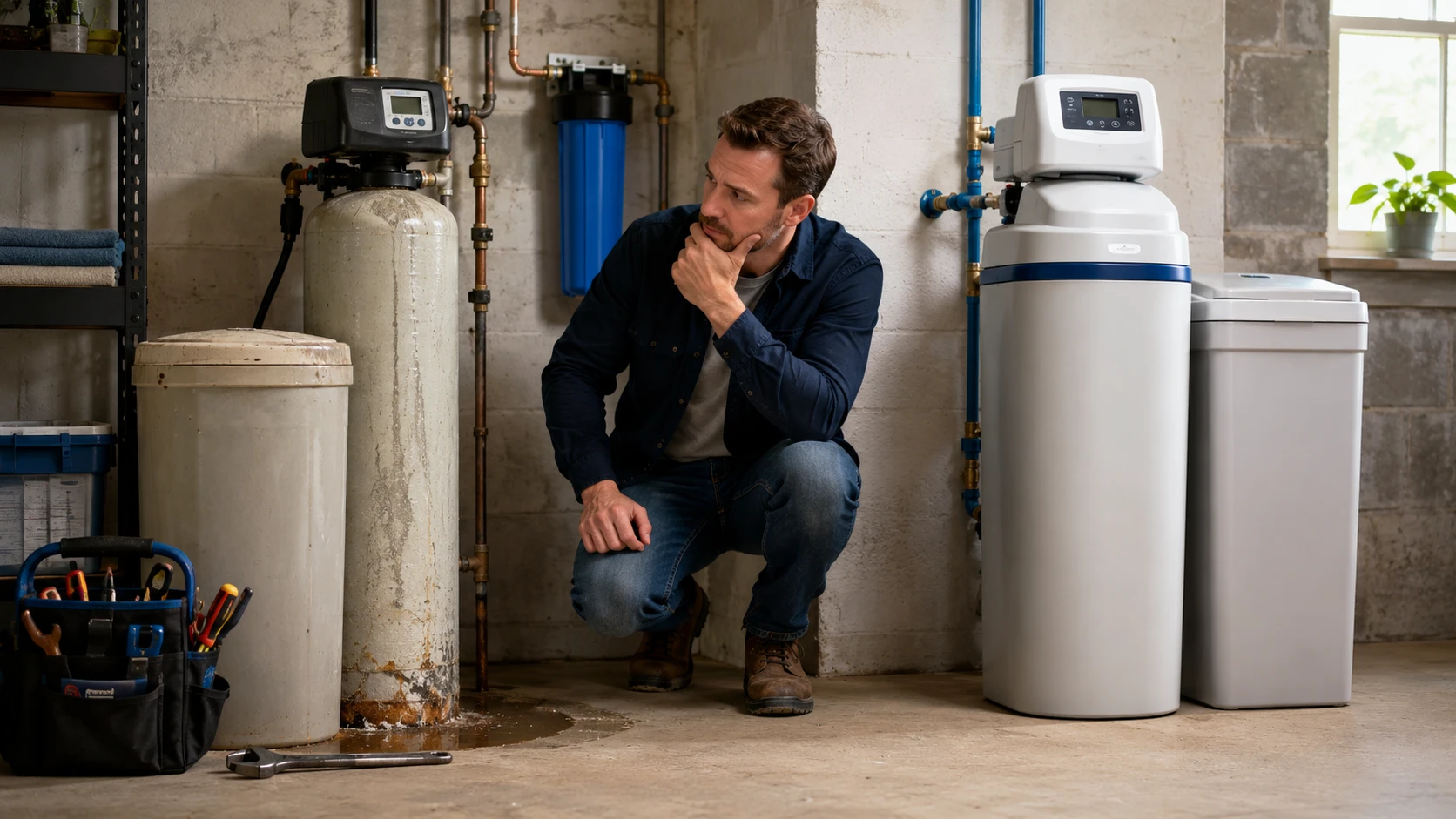
When a water softener stops doing its job, the signs come back quickly: spots on dishes, scale on the faucets, soap that will not lather. The question is whether the system needs a repair or whether it is time for a new one. The answer usually comes down to three things: how old the system is, what has actually failed, and whether it is still under warranty.
Check the simple things first
Some problems are not faults at all. Before you book a visit, look at these:
- Salt level. The brine tank should be at least a quarter full. An empty tank means the resin cannot recharge.
- Salt bridge. A hard crust can form above the water line and stop salt from dissolving. Push gently on the salt with a broom handle to see if it is hollow underneath.
- Bypass valve. If the valve was moved during other plumbing work, water may be skipping the softener.
- Power and clock. After a power cut, check that the control valve is on and showing the right time.
If hard water is still coming through after these checks, something inside the system needs attention.
When a repair makes sense
A repair is usually the right call when the system is fairly young and one part has failed. Control valve settings, a worn motor, a clogged injector, a leaking seal or a blocked brine line are all normal service work.
A repair also makes sense when the system is still covered. Zenith systems carry a written warranty of up to 10 years on parts and 5 years on labor, depending on the system, and repairs on our rental program are included at no charge unless the damage was caused by the customer. If you have a Zenith system, request a repair visit and we will find the fault, fix it and explain what we did.
When replacing makes more sense
Most water softeners last 10 to 15 years. As a system reaches that age, replacement often becomes the better use of your money. These are the usual signs:
- Age. The system is more than ten years old and starting to fail.
- Repeat visits. It has needed several repairs in the last couple of years.
- Worn resin. Hard water returns soon after each regeneration, even with enough salt.
- A changed household. More people or more bathrooms than the system was sized for.
- Salt and water use. Older timer-based systems regenerate on a schedule. Newer metered systems regenerate only when needed, so they use less salt and water.
Indianapolis water is very hard, about 317 ppm or 19 grains per gallon (see our Indianapolis water hardness guide), so a softener here works harder than it would in most places. Our article on how long water softeners last explains what shortens or extends that life.
Questions that settle it
- How old is the system?
- Is it still under warranty?
- How many repairs has it needed in the last two years?
- Is it the right size for the people living in the home today?
- Is it using more salt than it used to?
A young system with one failed part: repair it. An old system with a list of problems: replace it.
If your softener is another brand
Zenith repairs and services Zenith systems only, so we cannot fix another brand’s softener. What we can do is test your water for free, show you what your home needs, and give you trade-in credit toward a new Zenith system. The credit comes off the total price, and we remove the old softener and haul it away. If you would rather not buy, the rental program covers the system, service and repairs in one monthly payment.
Start with a water test
Whether you repair or replace, the decision is easier with real numbers. Book your free water test and our team will measure your water, look at the system you have and give you a clear recommendation.