
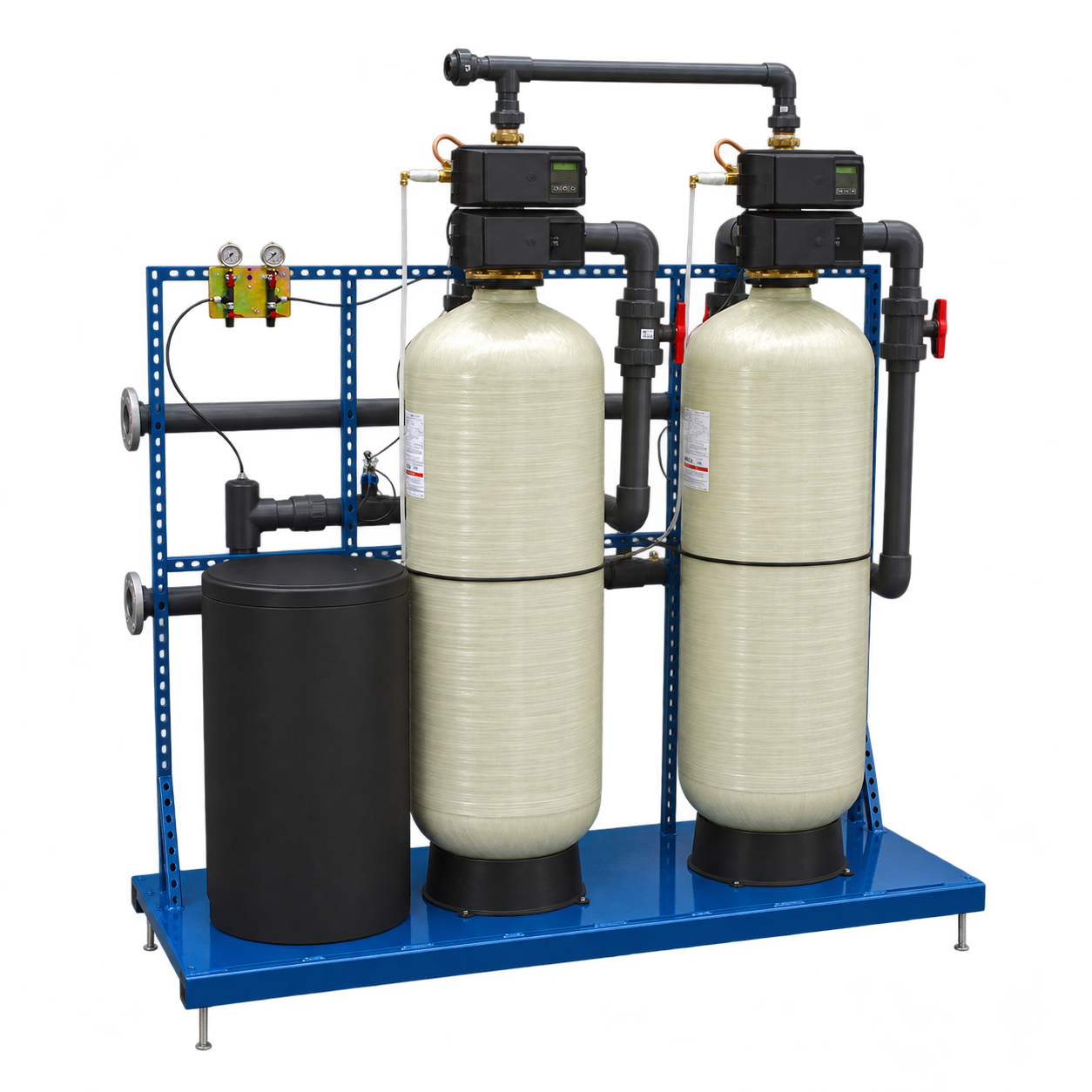
A commercial softener is not picked from a catalog. We build it around two things: how your site uses water and the room you have for it. Capacities run from 120,000 to 1,200,000 grains per tank, as a single tank, a twin, or up to four tanks working together.
Free on-site assessment · Written quote before any work starts · Indianapolis-based install and service team
- 120k to 1.2M Grains per tank, in eight sizes
- 1 to 4 tanks Single, twin alternating or parallel, depending on whether soft water can pause
- 24 × 42 in Floor space for the smallest system. The largest single tank needs 50 × 100 in
- 19 gpg Indianapolis city water hardness: 317 ppm, Citizens Energy Group 2025 report
Start with how your site uses water
Three things about your water use decide the system. We measure all three at the assessment.
How much water in a day
Sets the capacity
Daily gallons multiplied by hardness gives the grains the softener has to remove each day.
How fast at the busiest moment
Sets the tank and valve size
Peak flow in gallons per minute decides the tank diameter and the control valve. A softener with enough capacity can still be too small for the rush.
Whether soft water can pause
Sets the number of tanks
A site that closes can regenerate overnight on one tank. A site that never closes needs a second tank so soft water does not stop.
How we size a commercial softener
Daily gallons × hardness = grains per day
A restaurant using 800 gallons a day at 19 grains removes about 15,200 grains daily. Over a week that is roughly 106,000 grains, which a 120,000-grain system handles on a weekly regeneration.
A hotel using 5,000 gallons a day removes about 95,000 grains daily. That is daily regeneration on a single tank, or a twin alternating system if the site cannot be without soft water.
| Daily water use | Grains to remove a day | One way to cover it |
|---|---|---|
| 800 gallons | 15,200 | One 120,000-grain tank, regenerating about once a week |
| 2,500 gallons | 47,500 | One 150,000-grain tank, about every three days |
| 5,000 gallons | 95,000 | One 300,000-grain tank about every three days, or twin 120,000-grain tanks taking turns about once a day |
| 10,000 gallons | 190,000 | One 600,000-grain tank about every three days, or twin 210,000-grain tanks taking turns about once a day |
| 25,000 gallons | 475,000 | Twin 600,000-grain tanks taking turns about once a day |
| 50,000 gallons | 950,000 | Twin 1,200,000-grain tanks taking turns about once a day, or parallel tanks |
Worked at 19 grains per gallon and each tank’s full rated capacity, before any reserve. These are illustrations, not a quote: yours is sized from your own water test, peak flow and salt setting.
The question that decides it: can your site tolerate the regeneration window, or does soft water have to be continuous?
Then the room you have
A softener needs four things from the building: floor space, ceiling height, a drain and a power outlet. This is what each size takes.
| Capacity (grains) | Resin tank (in) | Brine tank (in) | Floor space (in) | Backwash (GPM) |
|---|---|---|---|---|
| 120,000 | 16 × 65 | 24 × 41 | 24 × 42 | 7 |
| 150,000 | 18 × 65 | 24 × 50 | 24 × 47 | 10 |
| 210,000 | 21 × 62 | 24 × 50 | 24 × 47 | 12 |
| 300,000 | 24 × 72 | 30 × 48 | 30 × 56 | 15 |
| 450,000 | 30 × 72 | 39 × 48 | 39 × 71 | 25 |
| 600,000 | 36 × 72 | 50 × 60 | 50 × 88 | 35 |
| 900,000 | 42 × 72 | 50 × 60 | 50 × 94 | 50 |
| 1,200,000 | 48 × 72 | 50 × 60 | 50 × 100 | 65 |
Tank sizes are diameter by height, in inches. Floor space is for one resin tank with its brine tank. Backwash is the flow sent to the drain during regeneration. Figures are the manufacturer’s general specifications and are confirmed for your system in the written quote.
- Floor. From 24 by 42 inches for the smallest system to 50 by 100 inches for the largest single tank. A twin or parallel system adds a resin tank for each extra unit.
- Height. Resin tanks stand 62 to 72 inches tall before the control valve and piping on top, so we check the ceiling and the doorway.
- Drain. Regeneration sends 7 to 65 gallons a minute to the drain, depending on size. The drain has to take that flow.
- Power. An electrical outlet for the control valve.
Tight on space? The same capacity can be built from two or more smaller tanks where one large tank will not fit through the door or under the ceiling. Where there is no drain or no room for a brine tank at all, salt-free scale prevention is the alternative to look at.
The system we build from that
Your use sets the capacity and the number of tanks. Your space sets the shape. These are the ways the tanks can work together.
Single tank
For sites that close
One resin tank and a brine tank. A metered valve counts the water used and regenerates the tank after hours, so soft water is ready when you open.
Restaurants, cafes, offices and small retail.
Twin alternating
For sites that cannot stop
Two tanks that take turns. One is in service while the other regenerates and then stands by, so soft water never stops.
Hotels, laundries and senior living.
Parallel tanks
For high flow
Two to four tanks in service together, sharing the flow. Each has its own meter, and only one regenerates at a time while the others carry the load.
Car washes, large hotels and institutions.
Demand-based
For big swings in use
Two to four tanks, with one in service and the rest standing by. Extra tanks come on line when flow rises and drop back when it falls, so the system is not oversized for the quiet hours.
Sites with a hard morning or evening peak.
Control valves are Clack and Fleck commercial valves, metered and programmed by our installers. Built with NSF certified components.
What goes with the softener
Commercial filtration
Carbon, sediment and specialty media
Backwashing carbon filtration for chlorine, chloramine and taste and odor compounds. Sediment and specialty media selected against your water test. Sized on contact time, not on tank size alone.
Also available: air-injection iron and sulfur removal for sites on well water.
Installation and service
Scheduled maintenance plans
Professional installation by our own Indianapolis team, then a maintenance schedule built around your system type and usage: salt, filter changes and performance checks.
Warranty: commercial terms are confirmed in your written quote before any work starts.
Monitoring
Where it earns its place
Leak detection on the supply and tank level monitoring can be specified. We will tell you when a site warrants it and when it does not.
Optional, specified as part of the assessment.
Need treated water for coffee, ice or production? See commercial reverse osmosis.
Water softener questions
How do you size a commercial water softener?
Daily gallons multiplied by hardness in grains gives the grains removed per day. A site using 800 gallons a day at 19 grains removes about 15,200 grains daily, which a 120,000-grain system handles on a weekly regeneration. The second question is whether your site can be without soft water while a tank regenerates. If not, you need a twin alternating system.
How much room does a commercial water softener need?
A single 120,000-grain system takes about 24 by 42 inches of floor for the resin tank and brine tank together. A 1,200,000-grain system takes about 50 by 100 inches. Tanks stand 62 to 72 inches tall before the valve on top. Where one large tank will not fit, the same capacity can be built from smaller tanks.
What is a twin alternating softener and do I need one?
Two tanks that take turns. One stays in service while the other regenerates, so soft water never stops. You need one if your site cannot tolerate a regeneration window, which is usually the case for hotels, laundries, senior living and anywhere that runs long hours.
Does a commercial water softener need a drain?
Yes. Regeneration flushes the resin and that discharge has to go somewhere, so a softener needs a drain that can take the backwash flow: 7 gallons a minute on the smallest system and up to 65 on the largest. If your site has no drain available, salt-free scale prevention is the alternative to look at.
What is the largest softener you install?
Single tanks run to 1,200,000 grains. For more capacity or higher flow we build twin or parallel systems of up to four tanks, specified on assessment.
Will a water softener make the water taste salty?
No. Ion exchange swaps hardness minerals for a small amount of sodium, and the salt in the brine tank regenerates the resin rather than entering the supply. The water does not taste salty.
How much salt will a commercial softener use?
Salt use follows the grains removed, so it tracks your water hardness and how much water you use. A metered valve regenerates on water used rather than on a timer, which avoids regenerating on quiet days. Each tank can also be set two ways: at full capacity, using 15 pounds of salt per cubic foot of resin, or at a salt-saving setting of 9 pounds that gives 80 percent of the capacity. On the smallest system that is 60 or 36 pounds per regeneration. On the largest it is 600 or 360.
Find out what is in your water
The on-site assessment is free. We test your water at your site, inspect any system already installed and give you a written quote, with no obligation.
Hardness figure: Citizens Energy Group 2025 water quality report, 317 ppm, about 19 grains per gallon. Tank sizes, floor space and backwash flows are the manufacturer’s general specifications.